
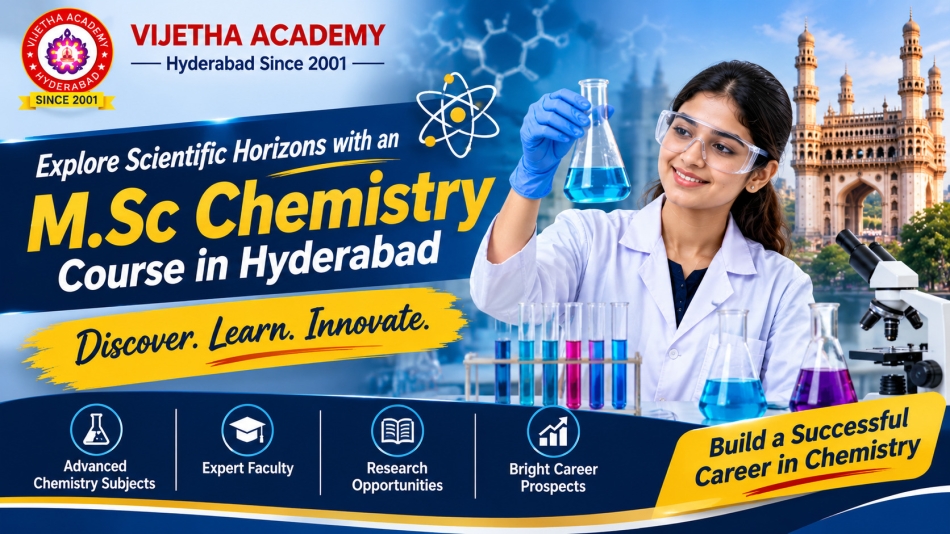
Medicine, environment protection, materials and industrial development are still affected by chemistry discoveries. Graduates interested in learning more about this development can explore it in more detail through the M.Sc Chemistry Course in Hyderabad can provide a chance to reinforce the scientific knowledge and delve into fresh academic paths. In addition to theoretical considerations, post-graduate chemistry students are encouraged to consider chemical processes, interpret experimental results and to understand how scientific principles are applied to solve practical problems.
Chemistry is a vital part of many products and processes used by people on a daily basis. Innovation in various industries relies on chemical knowledge, such as in pharmaceuticals, food testing, water purification, and the development of new materials. Thus, postgraduate study may be useful for the learner to link basic concepts to application.
Furthermore, a higher education fosters curiosity and accuracy in scientific questions. They learn to analyse data, comprehend chemical reactions and formulate logical explanations about experimental observations. These skills can be applied to additional schoolwork and career opportunities that involve the use of critical thinking.
A postgraduate chemistry program typically also covers organic, inorganic, physical and analytical chemistry. Students can also learn about spectroscopy, electrochemistry, computational chemistry, and other trends in the field based on the specialization and the university.
Every subject is taught from a different perspective of chemical science. Organic chemistry deals with compounds of carbon and its reactions, inorganic chemistry deals with metals, minerals and coordination compounds. In the same way, physical chemistry is used to help explain the principles of chemical behaviour, energy changes and reaction rates. Analytical chemistry deals with the identification of a substance and determination of its composition.
Therefore, learners will be able to build a wider understanding of a chemical system and their applications. Contents, practical requirements and elective subjects vary from one institution to another.
Experience is a good supplement to chemistry education at the post grade level. Laboratory sessions assist students in gaining insight into experimental techniques, witnessing chemical changes and carefully interpreting results. Moreover, learners can be introduced to instrumental methods, which are found in research and industrial testing, when working with analytical instruments.
In addition, the students learn to build accurate documentation practices, laboratory safety, and to analyze experiment limitations. These help to instil responsibleness and attention to detail.
Research assignments and project work also provide opportunities to help students pose questions, review evidence, and present their findings effectively and clearly. These experiences build a better base for scientific problem solving.
A solid understanding of advanced chemistry can help in career exploration in a variety of fields. Chemical analysts, with a background in formulation and quality testing are required by pharmaceutical companies. Similarly, chemical making companies require process monitoring, product assessment and lab skills.
Water quality, soil composition and pollutants are also chemically analyzed at environmental testing laboratories. Research institutes test new chemical compounds, materials and processes.
Graduates can pursue careers related to analytical laboratories, quality control, research assistance, technical services, and scientific education based on their qualifications, practical skills, and experience. The specific requirement for each job, however, is different and some will need further training or special skills.
When choosing a postgraduate course, it's not just about the name of the course. Students are advised to take into consideration curriculum, method of teaching, laboratory facilities, eligibility criteria, process of admission and research/practical training opportunities.
In addition, students should have an idea of what they want to learn in science. An aspiring pharmaceutical scientist might choose analytical or pharmaceutical chemistry, while another student might choose to specialize in organic synthesis, environmental chemistry or materials research. When you have a clear objective, it's easier to compare programs you're considering.
Vijetha Academy provides educational support to students interested in exploring educational opportunities that are a match to their academic background and career interests. The academy was started in 2001 in Hyderabad with the aim of educating the students about the various options they have, and helping them to choose their education carefully.
Students may ask for information on courses, qualifications, procedures, and learning styles. They need to make sure that they know the exact program before signing up, as well as what the university is affiliated with, whether it is recognized and practical requirements.
By carefully planning and reflecting on their learning, students can build a solid scientific base and be better equipped for their future scientific endeavours.
If you are interested in Chemistry, your study in the subject could begin in a successful academic path. Check out different programs, review course requirements and select a course that aligns with your future goals. Talk to the experts at Vijetha Academy about your educational objectives and learn about appropriate study programs. Take an assertive move towards augmenting your scientific expertise and career prospects today!
1. What is an M.Sc Chemistry program?
It is a postgraduate science program that develops advanced knowledge of chemical principles, analytical methods, laboratory practices, and selected areas of chemical research.
2. Who can apply for postgraduate chemistry studies?
Applicants generally need a relevant undergraduate science qualification with chemistry as a subject. However, universities establish their own eligibility criteria, minimum marks, and entrance requirements.
3. What subjects are covered in the curriculum?
Common subjects include organic, inorganic, physical, and analytical chemistry. Some universities also offer spectroscopy, computational chemistry, electrochemistry, and specialized electives.
4. What career opportunities can chemistry graduates explore?
Graduates may consider laboratory analysis, quality control, pharmaceutical testing, research assistance, environmental testing, and scientific education, depending on their skills and qualifications.
5. What should students check before choosing a course?
Students should verify university recognition, eligibility, syllabus, practical training, admission requirements, course duration, and suitability for their intended career or further studies.